习
practicar, aprender
De un vistazo · 习
Evolución del glifo
Cinco etapas, desde el dibujo del objeto hasta el kaishu: toque una etapa, arrastre la línea de tiempo o reproduzca la animación.


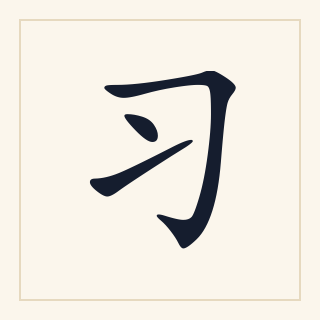
Dibujo del objetoAntes de escribir · dibujar lo que se veíaHueso oracularDinastía Shang · h. 1300–1046 a. C.Sello pequeñoDinastía Qin · 221–206 a. C.Escritura clericalDinastía Han · 206 a. C.–220 d. C.Estilo regularDe Wei-Jin a Tang · h. siglos III–IX d. C.
⚠ Algunas formas antiguas no están attestiguadas:forma en hueso oracular、forma en escritura sello。No hay artefacto en hueso oracular / sello para este carácter; lo dejamos en blanco en vez de inventar.
习字甲骨文从羽从白(或自),会意为鸟频频试飞,本义为鸟练飞,引申为练习。繁体作『習』。
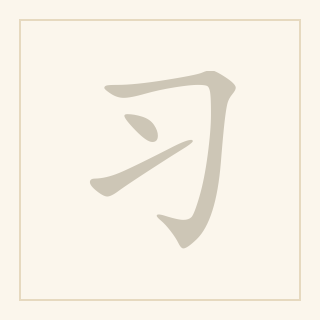
Qué muestra el dibujo
Origen y notas
习本义为鸟反复飞练,引申为学习、习惯。
Estructura
会意字,从羽从数点(多次),表示反复习飞。
De un vistazo
Pinyinxí
Radical乙
Trazos3
UnicodeU+4E60
Tipo de carácter会意
Tema动作
Seis idiomas, un solo carácter
Cada página ofrece versiones hreflang; al cambiar de idioma, los glifos y los significados siguen alineados.
English
practice, learn
Xi is an associative character of feathers and repetition, meaning to practice and learn.
Français
pratiquer, apprendre
Xi est un caractère associatif de plumes et répétition, signifiant pratiquer et apprendre.
Español
practicar, aprender
Xi es un carácter asociativo de plumas y repetición, significa practicar y aprender.
العربية
يتدرب، يتعلم
شي حرف تركيبي لريش وتكرار، يعني التدريب والتعلم.
Русский
упражняться, учить
Си — ассоциативный знак перьев и повторения, означает упражняться и учить.
Palabras comunes
- 学习xué xístudy
- 练习liàn xípractice