典
law
At a glance · 典
Evolution of the glyph
Five stages, from a sketch of the real object to regular script — tap a stage, drag the timeline, or play the animation.


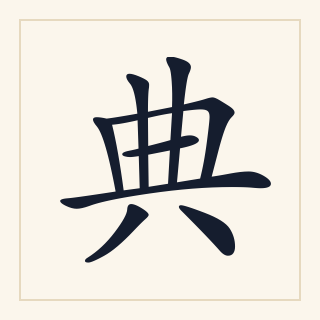
Object sketchBefore writing · drawing what was seenOracle boneShang dynasty · c. 1300–1046 BCESeal scriptQin dynasty · 221–206 BCEClerical scriptHan dynasty · 206 BCE–220 CERegular scriptWei–Jin to Tang · c. 3rd–9th century CE
⚠ Some ancient forms are not attested:oracle bone form、seal script form。No excavated oracle bone / seal artifact is attested for this character yet; we leave it blank rather than fabricate.
「典」甲骨文从冊在丌上,象双手奉册,金文小篆承之。
What the sketch shows
Origins & notes
「典」本义为重要文册、典籍,引申典制、典礼、典范。
Structure
从冊、从丌,会意字,象简册置于几,本为典籍、常法。
At a glance
Pinyindiǎn
Radical八
Strokes8
UnicodeU+5178
Character type会意
Theme器物
Six languages, one character
Each page offers hreflang versions; switching language keeps the glyphs and meanings aligned.
English
law
law, canon; documentation; classic, scripture
Français
classique / canon
Classique, canon. «既集坟典» : les canons.
Español
clásico / canon
Clásico, canon. «既集坟典»: los cánones.
العربية
كلاسيكي / كانون
كلاسيكي، كانون. «既集坟典»: الكنوز.
Русский
канон / классика
Канон, классика. «既集坟典»: каноны.
Common words
- 经典jīng diǎnclassic
- 典礼diǎn lǐceremony